Twelve sessions. Five months. One incredibly loud classroom.
We didn't want to dump information. We wanted students to build a feeling for how this stuff works — the same feeling you get when you've wired your tenth circuit and the LED comes on without you even thinking about it. So the arc starts gentle, gets weird in the middle (in the best way), and ends with student teams demoing projects they fully owned.
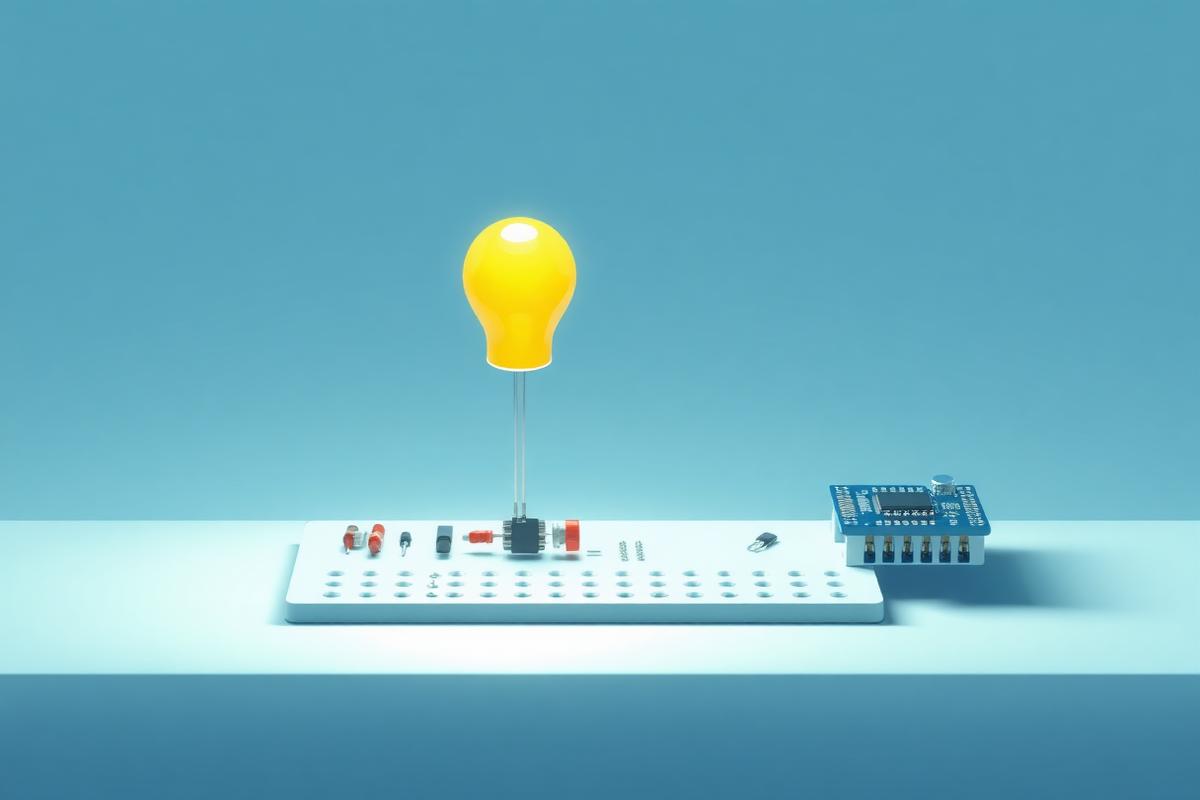
Welcome to electricity
Charges, current, voltage — but explained with water-pipe analogies, hand-drawn diagrams, and a battery + bulb that they wire up themselves before the period ends.
Building your first circuit
Breadboards, jumper wires, LEDs, resistors. The first real 'it works!' moment of the program. Plenty of intentional mistakes to debug.
Series vs parallel
Why does one bulb get brighter when you remove the other? Students wire both topologies and figure out the difference by observation, not lecture.
Measuring the invisible
Multimeters. Reading voltage. Reading current. Suddenly the abstract numbers in the textbook are real things you can point a probe at.
Switches, buttons, logic
Pushbuttons, slide switches, a tiny intro to logic. If-this-then-that, but in copper.
What's inside that thing?
Teardown day. Old remotes, calculators, broken toys. Identify the components. Realize technology isn't magic — it's parts.
Meet the microcontroller
Arduino-style boards. Pins, power, ground, the idea that a tiny chip can decide things. Blink an LED through code instead of a switch.
Sensors!
Light sensors, ultrasonic sensors, temperature. The board can now feel the world. Students design tiny experiments around each one.
Pseudocode workshop
Before syntax: thinking. Students write the logic of what they want to happen in plain English, then we translate together into real code.
Motors and movement
DC motors, servos, the physics of making something actually go. The classroom gets loud. That's a good sign.
Project ideation
Teams form. Ideas get pitched. We help scope them down from 'a self-driving car' to 'an obstacle-avoiding mini robot' — but the dream stays.
Build, code, demo
The final session. Every team presents their working project to the class, the teachers, and a very proud principal. Cheers, applause, the whole thing.
A few things we'd do differently
- Start with even more hands-on time in the first two sessions — kids learn the rules of the lab by being in the lab.
- Build a glossary card per session in both English and Hindi. We did this verbally; a written version would compound.
- Pair every loud kid with a quiet kid on day one. By the final project, those pairings became the strongest teams.
- Document each student's project with a short video, not just photos. The "explaining their own thing" moment is gold.